What is Surtension?
I made this game because I wanted somewhere to come back to every day, five minutes, the way you do the morning crossword — and because racing games bore me: going fast was never a decision in itself. So I turned the rule around. Here, speed is a currency. You earn it, you spend it, and sooner or later it sends you the bill. Everything else in the game follows from that.
In the browser, no account. A run lasts as long as you can hold it.
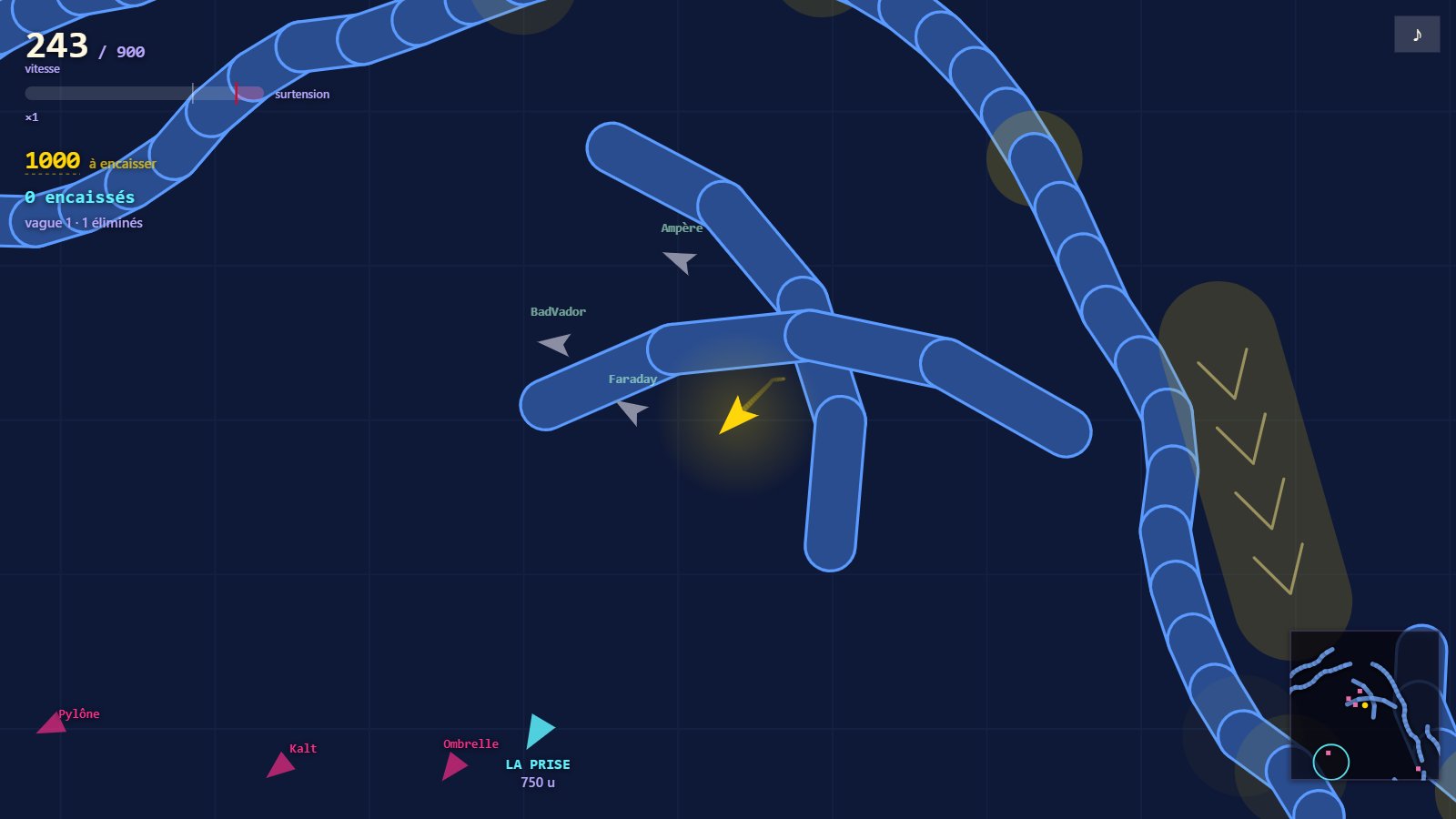
One control, and the boost
Your finger, or your mouse, sets both the direction and the throttle: the further you push, the faster you go — up to cruising speed, just under the gauge’s line. Beyond it, you boost on purpose: hold the click, put a second finger down, or hold Shift or Space. There is nothing else to learn, no attack button.
The difficulty comes from one law of physics: your turning radius grows with the square of your speed. At a stroll you turn on the spot. Flat out, you need a quarter of the map to come about, and the dashed circle ahead of you — the tightest turn you have left — spills right off the screen. That is the moment you have to anticipate instead of correct.
What decides a collision
When two racers touch, it isn’t the faster one who wins: it’s whoever pushes hardest along the line of contact, as in a real impact. Someone overtaking you flat out in a straight line pushes almost nothing towards you. You, slower, ramming them broadside, put all your momentum into their flank.
Speed is the ammunition, the angle is the shot. The fastest runner on the map turns so wide they can no longer face what attacks them — nobody is untouchable, and that is my favourite thing about this rule. Every rival is coloured by how the collision would end right now: green, you take them; pink, they take you. The colour changes as you turn. That is the whole tutorial, and it never says a word — with one exception: the first time, the door offers thirty seconds of practice (ram a green one, carry the charge back, unplug), and you can skip it.
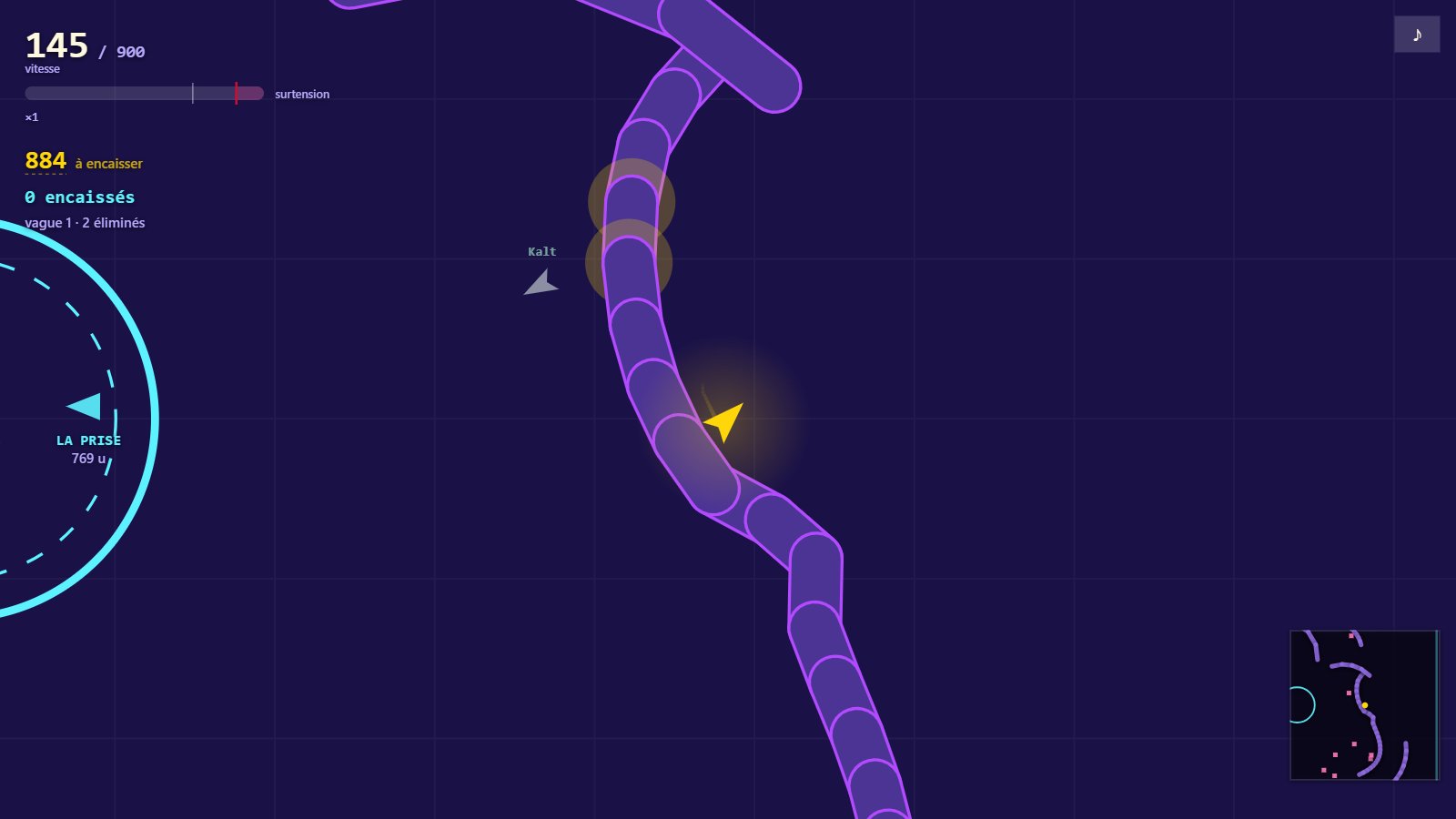
Overload, and what it costs
Your gauge rises with your speed. The higher it goes, the more everything you take is worth, up to four and a half times. Above the red line two things change at once: the circuit can blow out and take three fifths of what you haven’t banked, and a lost collision destroys you — where below the line it “only” costs you half your charge and your momentum. After a lost collision you get one second of respite: your ship blinks, and no rival can take anything from you while it does.
Dying here is not bad luck. It is something you chose by staying at the top of the gauge one second too long. I want that to stay true in every single run, and it is the thing I measure most.
Your charge isn’t yours yet
Each takedown is worth a hundred points, banked on the spot — even if you die right after. The rest of what you take from the others, the charge, is not a score yet: you have to carry it back to the socket, the ring at the centre of the map. And you can’t plug in at full speed — you must give up your momentum, which is both your weapon and your armour, while carrying everything you’ve earned. Inside the ring nobody can touch you. It’s the journey home that is dangerous.
Every deposit raises your speed ceiling. You become faster, so deadlier, so a little wider through the turns. It is the only kind of wealth this game knows how to give, and it is paid for in handling.
The socket’s perks
The socket opens three gates: at the start, then every time you bank five hundred there in one go. Each gate carries a perk, with its name and what it does written next to it. You choose by leaving through the gate you want: aim at it (mouse, finger, or W A S D and the arrows on a keyboard), it lights up, and you cross it. You keep the perk all run, and they stack.
Choosing doesn’t expose you: inside the socket nobody can touch you, and leaving through a gate gives you a one-and-a-half-second bubble, time to get back up to speed. In the bubble nothing can be taken from you, but you can still hit — except another player, live: between two players, during a bubble, nobody touches anybody. At the start nothing moves before your first gesture: take your time to read.
Lightning rod (lightning charges you instead of striking you, then the rod needs eight seconds to recharge), ricochet (walls bounce you back instead of wrecking you), shockwave (each takedown also takes down the greens around), wake (your trail slows rivals down), ghost (bank two hundred at the socket and you leave it untouchable), skimmer (near-misses pay three times more). None crushes the others: I measured them one by one.
The streak
Chain takedowns without letting six seconds pass: each one pays twenty percent more than the last, up to double. The streak breaks if you bank, lose a collision or blow the circuit. What it pays is charge: you still have to bring it home.
The boost strip
The golden chevron strips push you above your own ceiling. That is not a gift: beyond the ceiling the gauge climbs faster than by any other means, so that is where you go to find overload — but coming off the strip you are a projectile that can no longer aim, and it is the angle that decides collisions. It hands you the force and takes away the aim, at the same time.
Take it when it’s in front of you; don’t chase it. I measured both ways of playing across a hundred days or so: folding it into your line is worth it, detouring after it is not. And you may simply decline — cross it slowly and it takes nothing.
Earning without killing
Grazing pays: skimming a barrier without touching it earns you charge, the more so the faster you go and the higher your gauge sits. Forty-six units closer, and it’s an impact. It is the path for people who prefer precision to brawling. It pays less than a takedown, on purpose: you should be able to live without fighting, not to win by avoiding it.
And one big deposit beats three small ones — up to twice as much per unit as shuttling half-empty. That is what makes “one more takedown before I go home” so tempting, and so dangerous, since everything you carry is lost if you fall.
The colosseum, one map a day
The date makes the map: every player on earth faces the same ground, the same traps, the same opponents, until midnight. The ground is the colosseum: a ring around the socket with four gates at the cardinal points, four bastions on the diagonals, boost strips on the outer boulevard and two traps in the avenue of two gates. It is drawn for the game: gates where paths cross, room around the socket to bank, room to turn and to flee the storm, and a place you recognise at a glance on the minimap. Each day turns it a quarter turn, walls one gate up every other day and moves the traps. Before it, three families of terrain drawn from a curve took turns; the screenshots above come from them.
The countdown on the home screen says exactly when the map changes. One run a day counts: the first one you start on today’s map. That is the run you post and share, and it counts from the moment it starts — reloading the page halfway does not give it back. After that, play as much as you like, unranked. Your run is recorded as a replayable trace — that trace is what feeds the leaderboard.
Your opponents are real runs
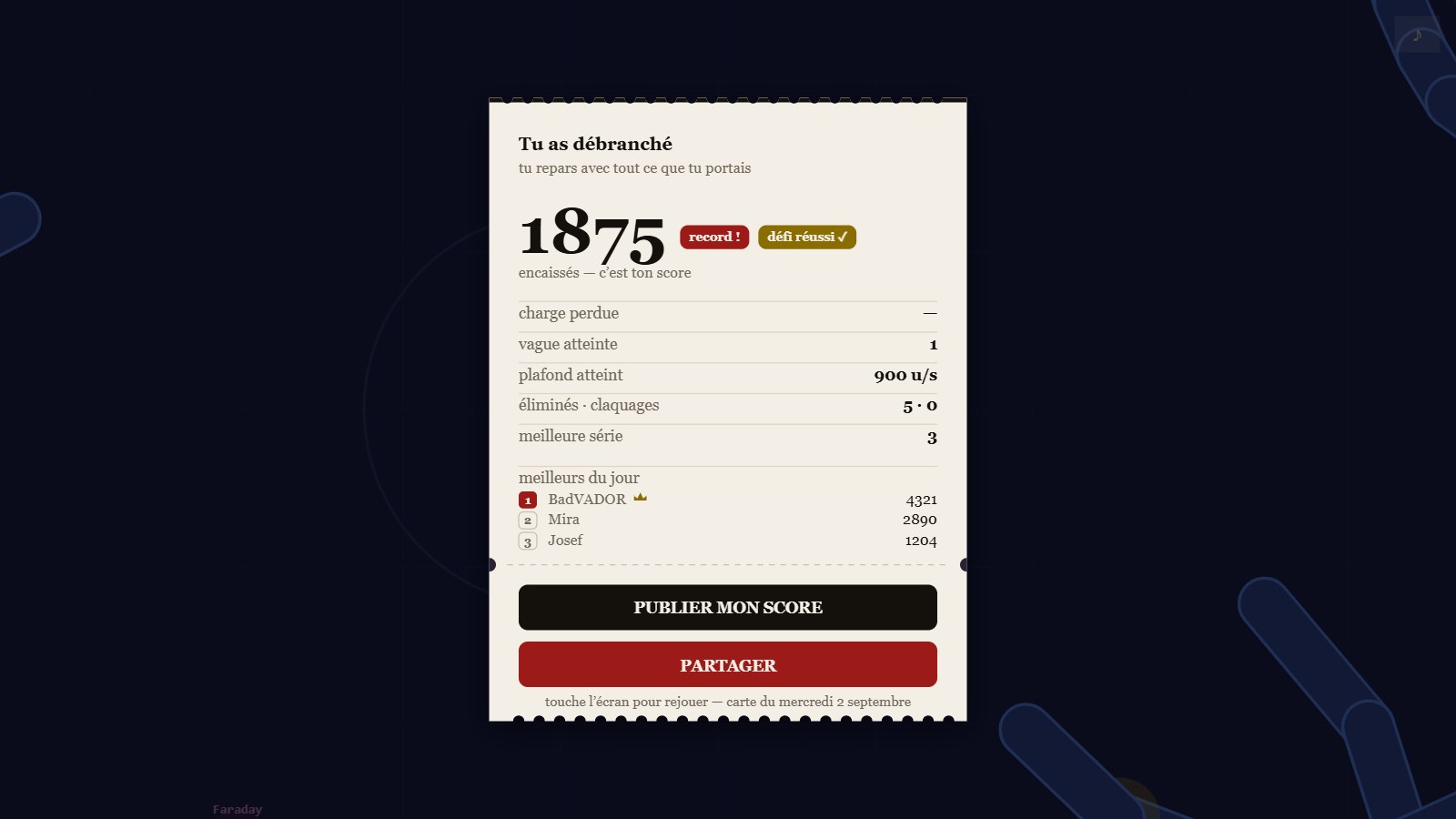
The racers on your map are not bots tuned to flatter you: they are runs actually played by other people, replayed input for input — ghosts. When you take down BadVADOR, you are beating BadVADOR’s real run, the one on the leaderboard. And posting your score sends your own run out to haunt other people’s maps: tomorrow, someone will be fighting what you did today.
On a map’s first morning, or offline, machines fill the empty seats. The game always tells you which is which — a game that dresses its robots up as humans is lying.
Playing live
The “play live” button opens today’s room: players connected at the same time as you race the same map, see each other, and collide for real. One nuance, which is a rule: a live run never goes to the leaderboard. The judge cannot replay a room full of living players, so rather than score it wrong, it doesn’t score it at all. You go there for the duel, not for the table.
Why you can’t cheat
The leaderboard doesn’t take your word for it. Your browser doesn’t send a score: it sends the sequence of your steering inputs, and the server replays it on its own machine, with exactly the same simulation code as the game. The number it keeps is the one it computed itself. So you can only lie about your own driving, which amounts to playing badly. That is why there is no account, no anticheat and no surveillance: the game doesn’t need them.
What it costs
Nothing. No account, no ads, no tracker, and nothing is for sale — I want a leaderboard without accounts to stay believable, and it wouldn’t be if a place on it could be bought. If you post a score you pick a nickname, and that’s all; the details are in the legal notice, which is in French because French law governs this service. I keep a development log too — in French as well, but the screenshots speak for themselves.